Latex
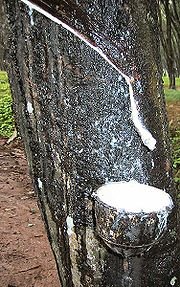

Latex, as found in nature, is the milky sap from the rubber tree (Hevea brasiliensis), which was found originally in the tropical climates of South America and is now cultivated in Southeast Asia. Europeans began experimenting with rubber in the mid-1700s, often founding large rubber tree plantations. Malaysia is currently the primary source of most of the world’s raw latex; the best quality comes from Malaysia and Thailand.
Liquid latex is actually a dispersion of rubber particles in water. Fresh raw latex consists of about 70 percent water and 30 percent rubber cells. The fresh latex is centrifuged, which concentrates it to approximately 60 percent solids.
Latex must be mixed with additives before it can be used in industrial processes. Certain chemicals are mixed in to achieve a desired thickness, rate of drying, and other properties. Other chemicals (collectively known as antidegradants) are added to slow the oxidation and decomposition of the rubber. To give it colour, pigments are mixed into the latex. The pigments may be fine metal oxide powders or organic dyes.
In 1921, a method of retarding the coagulation of liquid latex was developed. This method enabled rubber makers to transport raw latex in a liquid form more easily to manufacturing centres around the world.
Nowadays, rubber is also made synthetically from petroleum.
See also
- Latex allergy
- Latex clothing
- Latex fetish
- Latex sheeting
- Rubber fetishism
- Category:Fetish clothing
- leatherette
- PVC
- Rubber
- Second skin
References
- Barlow, Fred W. Rubber Compounding: Principles, Materials, and Techniques. Marcel Dekker, Inc. 1988.
- Coates, Austin. The Commerce in Rubber: The First 250 Years. Oxford University Press, 1987.
- Hofmann, Werner. Rubber Technology Handbook. Oxford University Press, 1989.
